

Sweeping Under the Rug
BY CRISTIAN PASAT AND OXANA CAPATINA
“Sweeping Under the Rug” is a performance piece created by artists Oxana Capatina and Cristian Pasat. The project emerged spontaneously during a visit to the landfill in Văsieni, Oxana’s native village. The two artists often explore such places, drawn to abandoned objects and the stories hidden among discarded things.
During these explorations, the artists recover film photographs, books, sketches, clothes, artworks, objects of cultural value, and everyday items. These are researched, documented, and artistically reinterpreted. Through this practice, they try to understand where an object’s usefulness ends, who decides that it no longer has value, and what is lost when it is abandoned.
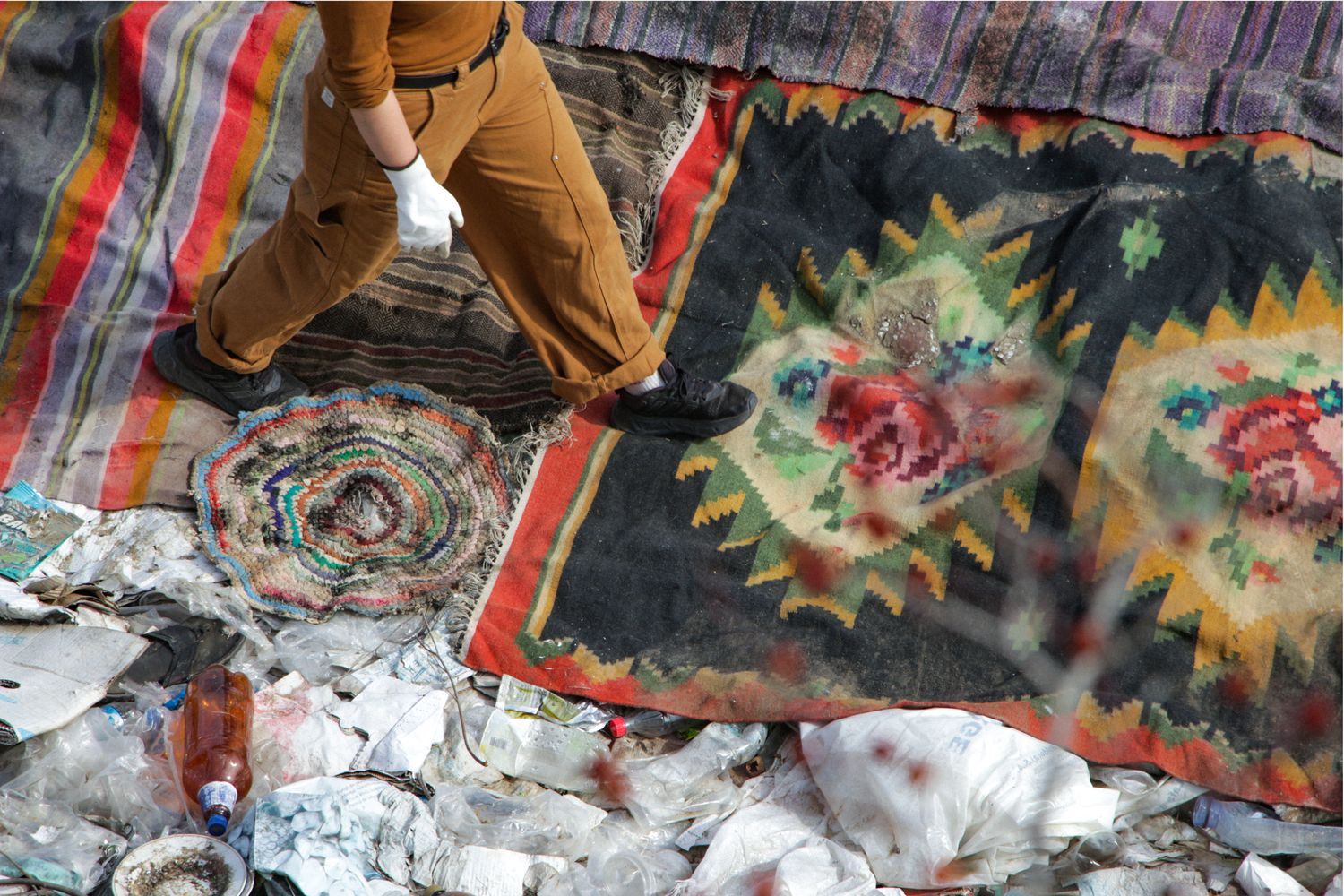
The idea for the work appeared one spring day, when the artists noticed many discarded carpets at the landfill. Many were still intact and could have been used, kept, or transformed. Among them were carpets with traditional patterns, connected to the memory of homes and families in the Republic of Moldova.
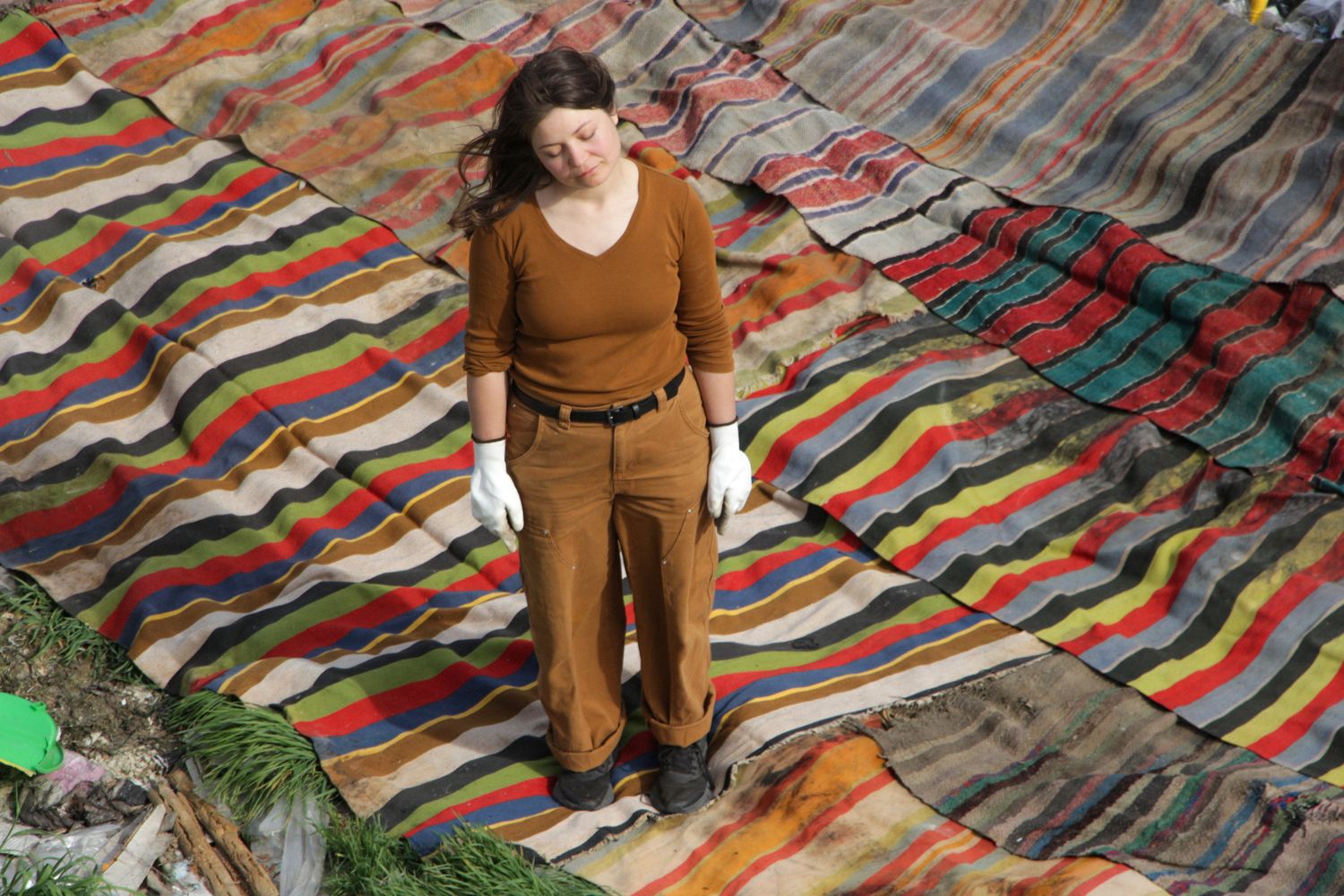
In the middle of this chaos, Oxana began collecting the carpets and carefully placing them next to one another, as if at home. From approx. 30 carpets, an ordered surface emerged that, for a few moments, seemed like a pause in the surrounding chaos. This gesture became the central action of the performance, while Cristian documented the process, choosing the way this transformation would be seen and preserved.
The title comes from the expression “to sweep the trash under the rug.” In the work, the meaning is reversed: the rug no longer hides the problem, but becomes trash itself and makes the problem visible. The performance draws attention to waste, excessive consumption, and the ease with which we discard things that are still usable, while also speaking about memory, identity, and the fragility of material heritage.
This place of degradation becomes an involuntary archive of the community, where personal objects, traces of everyday life, and fragments of local culture come together what Cristian also calls an open-air museum.
The performance was published online, reshared by the community, featured by press Moldova.org, and later presented at the Artcor Center for Creative Industries.
“Sweeping Under the Rug” is part of a series of five performances related to landfills, ecology, and people’s relationship with abandoned objects. The artists are developing the next parts of the series, continuing to explore these sites and the objects found there.
WHAT ARE YOUR HOPES AND FEARS AS A YOUNG PERSON IN A TIME OF ECOLOGICAL CRISIS?
We grew up watching waste multiply around us, while plastic became increasingly present in everyday life. Today, we find it in fields, orchards, along roads, and in villages. Consumption has increased, but the Republic of Moldova still lacks enough collection and recycling centers, while education around responsible consumption remains insufficient. Waste pollutes the soil, rivers, wells, and air. It is often buried or burned, affecting both health and the environment. For such a small country, more than 2,000 illegal dumpsites and 1,100–1,200 landfills that do not meet standards represent a disaster. We fear that plastic and pollution will become the legacy left to future generations. Yet we hope for a change in mindset. We expect the authorities to introduce coherent policies, recycling centers, accessible separate waste collection, control over illegal dumpsites, and environmental education. We try to consume consciously, reuse objects, and document through art what society ignores. After publishing the video “Sweeping Under the Rug” we felt it sparked a wave of online discussion. More and more young people are speaking about the issue and posting videos documenting illegal dumpsites in their villages and towns. These reactions give us hope and show that art can make the crisis visible, turn concern into dialogue, and encourage involvement. Art cannot replace political action, but it can change how people see the problem and choose to act.