

A Wild Hope of Unbounded Seeing
BY ISHITA SHARMA
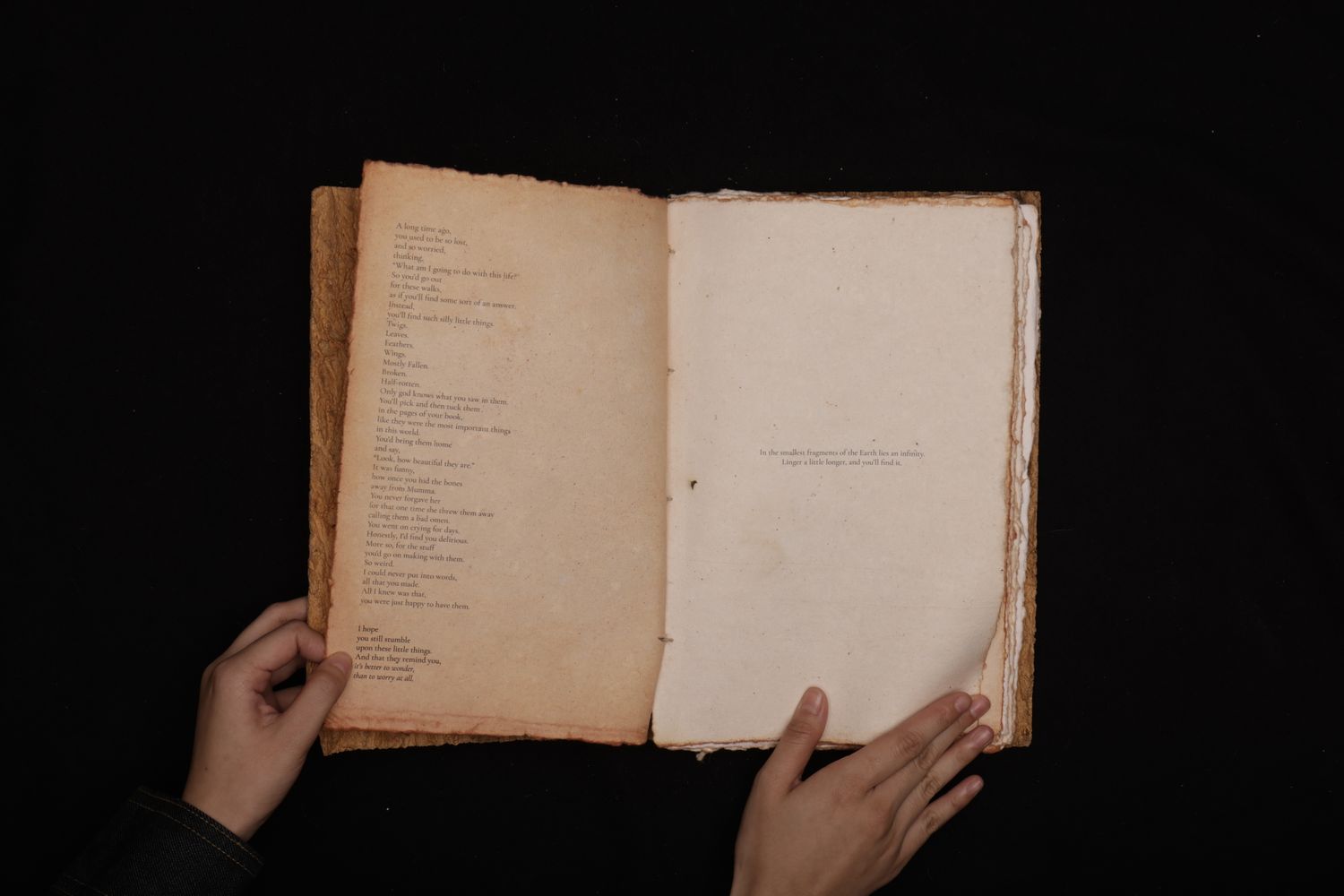
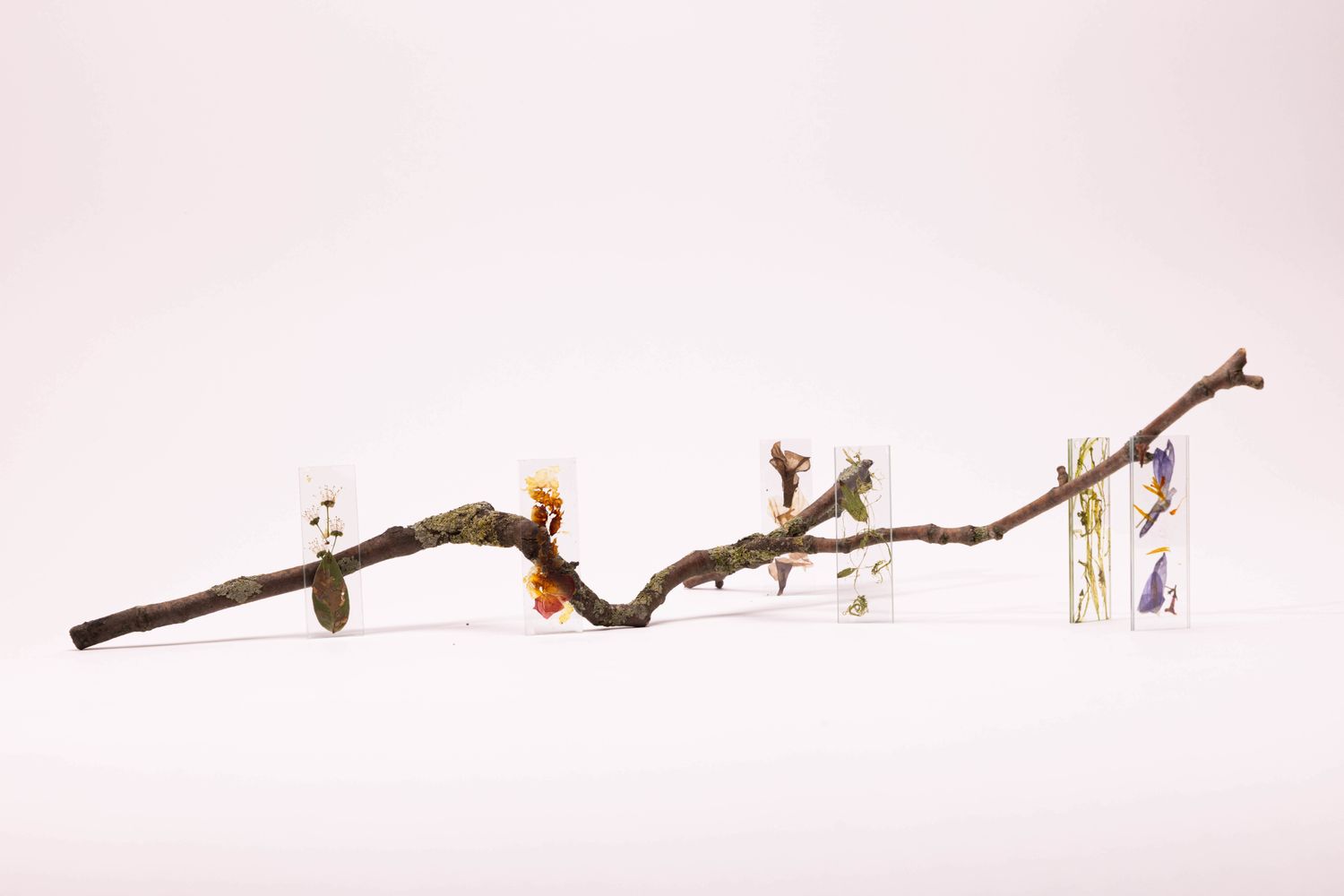
A Wild Hope of Unbounded Seeing is a multimedia project exploring human, more-than-human entanglement through the material agency of the Earth. Accumulating as a forest of contemplation, it comprises writing, experimental film, sound, photography, material paintings, sculpture, and a book, each medium drawing from the latent infinities of our environment to make visible the material forces at play around us.
Working with found natural matter gathered over time, dried, and carefully assembled, the project draws focus back to our immediate environment, cultivating the act of noticing as a quiet rebellion against our ignorance of the planet. It began in the material lab, under microscopes where close observation of matter ignited a sense of wonder, transforming a device of scientific inquiry into a site of material reverie. Macro to micro: through projection, the resulting installations offer space for material meditation, inviting viewers to sit with the residue of a landscape rather than its image. These interactions became sites of expanded awareness, revealing perception as a relational process shaped through attunement, not observed from a distance, but felt through proximity and time.
As the research evolved, matter proved not merely to influence perception but to evoke a form of reverie, cultivating wonder through sustained observation, what Gaston Bachelard calls a poetic mode of seeing, an imaginative dive into the latent infinities within matter, and within the self.
At a moment when the climate crisis is often narrated through scale and statistics, this project proposes a different register: attention as ecological practice. To notice a fragment of bark, a grain of sediment, a trace of moss, is to resist the abstraction that lets the Earth be treated as inexhaustible resource. The work invites new ways of understanding human/more-than-human entanglement, not as ecological premise, but as material condition, felt in the hand, underfoot, and in the quiet act of paying attention.
WHAT ARE YOUR HOPES AND FEARS AS A YOUNG PERSON IN A TIME OF ECOLOGICAL CRISIS?
I fear I’ll forget what is real. The Anthropocene closes itself further, every day, from the ecology that sustains it. We live inside a kind of illusion: a self-appointed dominion that makes us, in practice, the planet’s most thorough coloniser. We go to war with ourselves at the cost of other lives. I fear the quiet extinctions we don’t mourn because we never learned their names, the sand dredged from someone else’s coastline to build our skyline, the mangrove we forgot to remember. I believe we are nature, and that we are self-destructive: one instinctive, the other learned. To policy-makers, I’d offer this: ecological crisis is never only ecological. It is a subjective way of understanding the world that bleeds into every inequality, land, gender, resource, and I think often of eco-feminism here. Whose land is it, really, that we go to war over? Whose oil? Countries kill for what was never truly theirs to claim. And nature is not passive. It will resist. Sometimes it feels less like collapse and more like counterculture. My contribution is a belief that art can help repair this. I work through a subjective, felt understanding of ecology, taking scientific instruments, symbols of our pride in mastering the world, and returning them toward intimacy and reciprocity instead of extraction. I fear our forgetting most of all. But I remain hopeful. I see more people drawn toward biophilia, even when it looks like trend before it becomes practice. I hope we understand our place.